How to Become a Color Analyst
How to Become a Color Analyst
If you're fascinated by personal color analysis, you may have wondered whether you can learn to analyze color professionally — and perhaps even turn that skill into a service or business.
You can. Becoming a color analyst starts with learning how color interacts with real people, developing a structured analysis process, and then practicing until you can make confident, consistent color decisions for clients.
Training • Professional Tools • CertificationWhat does it take to become a color analyst?
To become a professional color analyst, you need to learn the principles of personal color harmony, develop a repeatable method for evaluating clients, practice analyzing real people, and learn how to translate your analysis into useful color recommendations.
You can then choose whether you simply want professional color analysis training or want to pursue a certification credential as well.
Explore professional online color analysis for free.
Get free access to the Your Color Style Professional Tools Training and see the workflow used to prepare client photos, compare color, work with professional palettes, and create client results.
What does a color analyst do?
A color analyst helps people identify the colors that work most harmoniously with their natural coloring.
During an analysis, the analyst compares how different color characteristics interact with the client's skin, hair, eyes, and overall appearance. The goal isn't simply to decide whether someone looks good in blue or red. A trained analyst learns to recognize why certain versions of those colors work better than others.
The final result is typically a personalized color palette the client can use when choosing clothing, accessories, and other colors they wear.
Professional color analysts may offer services such as:
- In-person personal color analysis
- Online or virtual color analysis
- Personalized digital color palettes
- Wardrobe and styling consultations
- Group color analysis events and workshops
- Additional image, style, or beauty services
What do you need to learn to become a color analyst?
Professional color analysis requires more than memorizing a collection of color palettes. You need to understand what you're seeing and why one group of colors may be more harmonious than another.
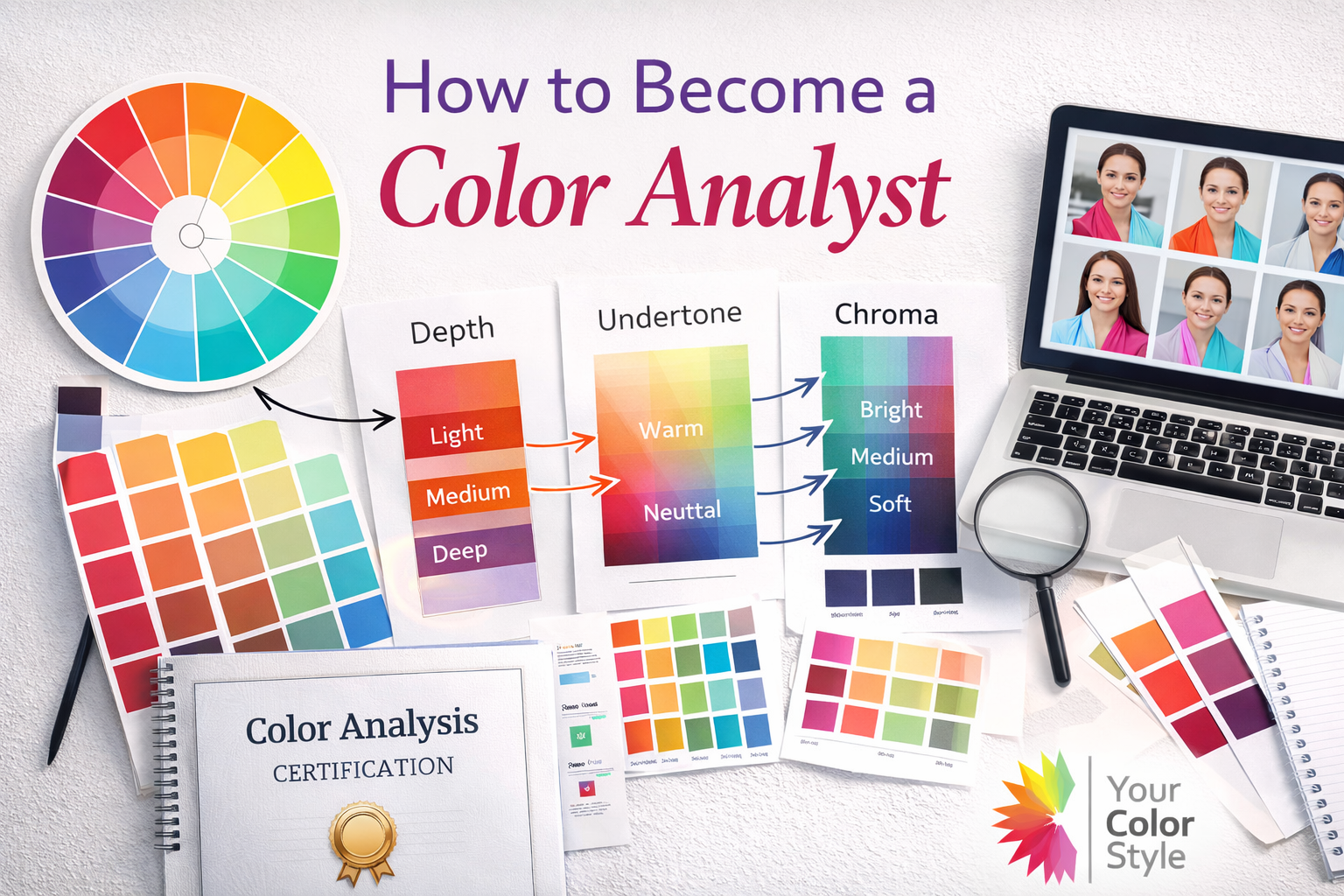
The Your Color Style methodology begins with three fundamental color characteristics:
Depth
How light or deep color needs to be to create harmony with someone's overall coloring.
Undertone
How warm, cool, and olive characteristics influence which colors interact most successfully with the skin.
Chroma
Whether clearer, brighter colors or softer, more muted colors create greater harmony with the individual.
These characteristics give an analyst a framework for comparing color rather than relying solely on rules or first impressions.
But real people are nuanced. Professional training should also teach you how to evaluate coloring that doesn't always fit neatly into common assumptions — including gray hair, olive skin tones, brown skin, varying levels of contrast, and combinations of characteristics that require a more thoughtful analysis.
How to become a professional color analyst
There isn't just one path into professional color analysis. Some analysts begin as personal stylists, makeup artists, boutique owners, or image consultants. Others start with no professional fashion or styling experience at all.
Regardless of your background, the learning process generally involves the same fundamental steps.
Learn color analysis fundamentals
Begin by learning how color characteristics such as depth, undertone, chroma, and contrast influence personal color harmony.
Learn a structured analysis process
A professional methodology gives you a repeatable process for evaluating clients instead of guessing or relying on isolated traits such as hair or eye color.
Practice analyzing real people
Textbook examples can teach principles, but experience comes from working with real people whose coloring may be far more nuanced.
Learn to create useful client results
A professional analysis should give the client something practical they can use — such as a personalized palette, color recommendations, visual examples, or a professional color analysis report.
Decide whether certification fits your goals
Professional training and professional certification aren't necessarily the same thing. You may choose to learn the methodology and use the skills professionally, or pursue a formal certification pathway that includes additional practice, evaluation, mentoring, and credential requirements.
Can you learn color analysis online?
Yes. Color analysis training can be completed online, and digital tools have also made it possible for analysts to provide professional color analysis services remotely.
For someone who wants to work online, however, learning color theory is only part of the process.
You also need to understand how to work with client photographs, evaluate color accurately on screen, make controlled color comparisons, and recognize when the quality or accuracy of an image may affect your analysis.
At Your Color Style, professional students learn a structured three-step approach to evaluating Depth, Undertone, and Chroma, along with the nuances that influence the final analysis.
You can learn more about the methodology and the available learning paths on our Online Color Analysis Training & Certification page.
See the professional color analysis tools in action.
Before you decide whether professional training is right for you, get free access to our Professional Tools Training and see how a modern online color analysis workflow actually works.
You'll get a behind-the-scenes look at the tools used for client photo preparation, structured color analysis, digital draping, professional color palettes, client management, and reports.
Get Free TrainingDo you need color analysis certification?
Training and certification serve different purposes.
Professional training teaches you how to perform color analysis. Certification adds a formal credential and typically requires additional practice, evaluation, and demonstrated competency.
Which path makes sense depends on what you want to do with your training.
If your primary goal is to learn professional color analysis or add color analysis to skills you already have, professional training may be enough for your needs.
If you want to become a Certified Your Color Style Color Analyst, the YCS Certification pathway includes additional requirements, evaluation, professional mentoring, and ongoing education.
Can you make a business out of color analysis?
Color analysis can be offered as a standalone professional service or incorporated into a broader styling, image, beauty, or consulting business.
Some analysts work with clients locally. Others provide virtual services and work with clients online. Color analysis can also complement services such as personal styling, wardrobe consulting, personal shopping, image consulting, and related client services.
You don't need to come from the fashion industry.
People who learn professional color analysis come from many different backgrounds. Some are already stylists or image professionals. Others are entrepreneurs looking for a new service to offer, and some simply begin with a fascination for color and decide they want to learn more.
Choosing a color analysis training program
Before choosing a program, think about what you actually want from the experience.
Do you simply want to learn the methodology? Do you want an instructor to review your work while you're practicing? Are you planning to work professionally? Is earning a certification credential important to you?
At Your Color Style, those are separate learning paths so you can choose the level of education and support that fits your goals.
Choose how you want to learn.
Learn independently through Professional Training + Tool, add structured assignments and personal feedback through Guided Training, or pursue the complete Certified Your Color Style Color Analyst pathway.
Becoming a professional color analyst
How do I become a color analyst?
Start by learning the principles of personal color harmony and a structured method for analyzing characteristics such as Depth, Undertone, and Chroma. From there, practice your analysis skills on real people and learn how to translate your findings into useful client color recommendations.
Can I learn color analysis online?
Yes. Professional color analysis training can be completed online. Online training is especially useful if you also want to learn how to perform virtual color analysis using client photographs and digital color comparison tools.
How do I get certified in color analysis?
Certification requirements vary by color analysis system. The Your Color Style Certification pathway includes professional training, structured practice, evaluation, competency requirements, mentoring, and the requirements needed to earn the Certified Your Color Style Color Analyst credential.
What's the difference between color analysis training and certification?
Color analysis training teaches you the methodology and skills needed to perform an analysis. Certification is a professional credential that requires additional evaluation and demonstrated competency. Your Color Style offers both training-only and certification pathways.
Do I need fashion or styling experience to become a color analyst?
No. Some students already work in styling, beauty, or image consulting, but prior professional experience isn't required to begin learning color analysis.
Can I become a color analyst if I already use another color system?
Yes. Professionals who already have color analysis experience can learn the YCS approach to Depth, Undertone, Chroma, and more nuanced coloring and incorporate those skills into their existing professional framework.
What if I already know how to perform color analysis?
If you're already professionally trained and primarily need digital tools, Your Color Style also offers the Professional Color Analysis Tool separately. It can be used with YCS digital palettes or with your own professional color palettes.
Curious whether professional color analysis is right for you?
Start with our free Professional Color Analysis Training to see the tools and online workflow in action. If you're ready to begin learning professionally, you can also compare the self-paced, guided, and certification paths.